The pour over in portrait: cone, flat bottom or ceramic, which paper, which kettle and why pour over is the method that shows origin and roast most clearly. With the accessories that are really needed.
A pour over is a funnel with paper in it. It costs little, has no electronics and no pump, and it is still the tool with which roasters and competition baristas show their coffee. Because it hides nothing.
The shapes
- Cone with a large opening: The water runs fast, and the grind and the pouring technique decide the extraction. Clean and lively, but sensitive to mistakes.
- Cone with a small hole: The brewer slows the flow. More even and more forgiving, with a little more body.
- Flat bottom: The coffee bed is flat and the water flows through it evenly. Balanced and repeatable, ideal to start with.
- Ceramic, glass, plastic, metal: Plastic holds the heat best, ceramic has to be preheated. Metal looks good and cools down fast.
The paper
Bleached filters taste more neutral than unbleached ones. Every filter has to be rinsed before brewing. Thick, dense papers slow the flow and give more body, thin papers let more oils and fines through. Metal and cloth filters give fuller, cloudier cups.
The accessories
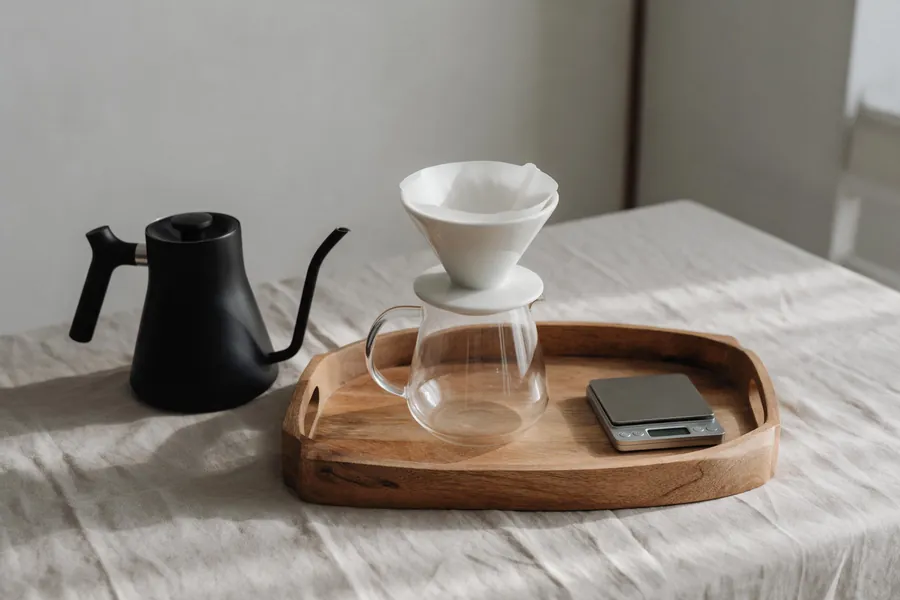
A grinder is essential, a scale very sensible, and a gooseneck kettle makes the pour controllable. A thermometer is handy if the kettle has no temperature setting. All in all 100 to 250 euros for a set up that lasts decades.
Who it is for
For everyone who wants to taste coffee, not just drink it. For people who enjoy a short morning ritual, and for travellers, because the brewer fits in any bag. Not for households with six coffee drinkers and not for espresso fans.
For
- Shows every origin most clearly
- Cheap, small, indestructible
- Full control
- A meditative ritual
Against
- Needs attention and practice
- One cup after another
- No espresso, no milk
- A good grinder and kettle are needed
Common questions
Which pour over brewer is best for beginners?
A flat bottom brewer made of plastic. It holds the heat, forgives pouring mistakes and gives consistent results.
Do I need a gooseneck kettle?
Not necessarily. It makes slow pouring easier, but with patience any kettle with a narrow spout works.
Share