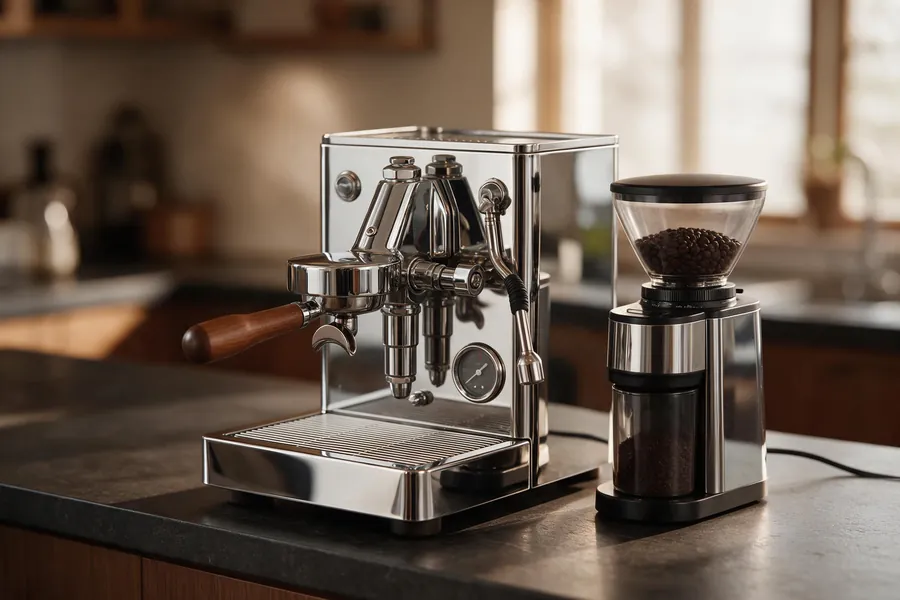
The espresso machine in portrait: single boiler, heat exchanger, dual boiler, what they cost, which accessories you need and why the grinder matters more than the machine. With an honest look at effort and learning curve.
An espresso machine does nothing automatically. You grind, dose, tamp, start and stop. That is exactly its appeal: it hands you every variable, and with them the chance to pull an espresso that most cafés cannot serve. The price is time, practice and a spot on the counter that never comes free again.
The types
- Single boiler: One boiler for brew water and steam. Espresso at 93 degrees, then heat up to steam, then cool down again. Cheap, compact, fine for one or two milk drinks a day. From 300 euros.
- Thermoblock: A flow heater instead of a boiler. Hot quickly, often with PID control. The most compact type for small kitchens. From 400 euros.
- Heat exchanger: A steam boiler with a heat exchanger running through it for the brew water. Espresso and steam at the same time, but the brew temperature drifts. The classic for milk drinkers. From 1,000 euros.
- Dual boiler: Two separate boilers with their own controls. Constant temperature, steam at the same time, every option. From 1,200 euros.
- Lever machine: You create the pressure with a lever. No pump, often no electricity. For purists with patience.
The grinder
Without a grinder that adjusts fine and in small steps in the espresso range, any espresso machine is useless. Pre ground coffee does not work, because it is too coarse and too old. Budget at least a third of the machine budget for the grinder. A 500 euro machine with a 400 euro grinder beats a 1,500 euro machine with a 100 euro grinder every time.
Accessories that really help
A scale with 0.1 gram resolution, a tamper that fits the basket, a distribution tool and a knock box. Everything else is optional.
Who it is for
For everyone who loves espresso or milk drinks, enjoys a morning ritual and is willing to invest time. Not for people who want coffee at the press of a button, and not for households where everyone drinks something different and nobody maintains the machine.
Running costs
Coffee stays the biggest item: at two espressos a day that is around 13 kilos a year, so 300 to 500 euros. Add descaling, gaskets every few years and cleaning powder. Electricity matters because of the heat up time, and a timer socket helps.
For
- The best espresso you can get at home
- Full control over every variable
- Real milk foam with a steam wand
- Lasts decades if looked after
Against
- Needs a good grinder, which costs another 200 to 600 €
- Heat up time of 15 to 25 minutes
- A learning curve of several weeks
- Cleaning after every shot
Common questions
What does a good espresso machine cost?
To start, 300 to 600 euros plus 200 to 400 euros for the grinder. For a carefree set up with milk, around 1,200 to 2,000 euros including the grinder.
Single boiler or heat exchanger?
If you rarely steam milk, a single boiler serves you well. If you drink cappuccino daily, a heat exchanger or dual boiler saves a lot of waiting.
Share