Coffee is 98 percent water. Which hardness is ideal, why distilled water tastes bad, how to check your tap water and when a filter or self mixed brew water makes sense.
In short
- The target: medium soft water, around 50 to 100 mg of minerals per litre, carbonate hardness 2 to 4 °dH.
- Water that is too hard makes coffee dull and ruins the machine, water that is too soft makes it sour and flat.
- A jug filter is usually enough; anyone who wants precision mixes their own brew water.
You can buy the best bean and nail the grind, and the coffee still tastes better at your friend's place. The reason is often the water. It is not just a carrier but a solvent, and its minerals decide what comes out of the coffee.
What minerals do
Magnesium and calcium pull the aromatic compounds out of the coffee. Without them, as in distilled or reverse osmosis water, coffee tastes empty and sour. Bicarbonate, the carbonate hardness, buffers acids. Too much of it makes coffee dull and chalky and settles as limescale in the machine.
Target values
- Total hardness: 4 to 8 degrees German hardness, which is medium soft.
- Carbonate hardness: 2 to 4 degrees German hardness, so that the acidity of the coffee can still be tasted.
- Chlorine: none. You smell chlorine in the cup immediately.
Checking your tap water
Your water utility publishes its analysis online. Look for total hardness, carbonate hardness (also called acid capacity) and chloride. If total hardness is above 14 degrees German hardness, as it is in many regions with chalky soil, you need treatment. With very soft water below three degrees, typical of upland and granite regions, minerals are what is missing instead.
Three routes to better water
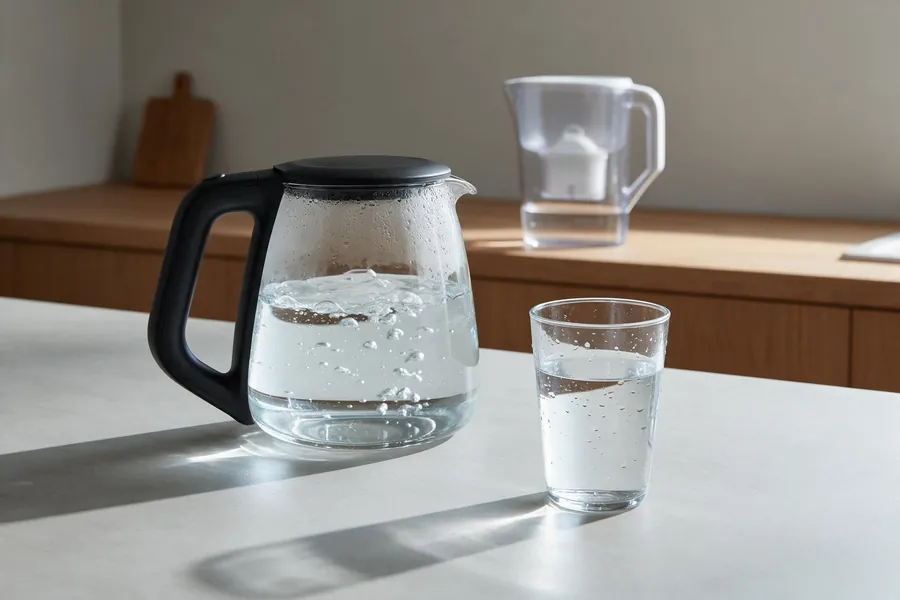
- Jug filter with an ion exchanger: Lowers carbonate hardness and binds chlorine. Enough for most households. Change cartridges regularly, otherwise the filter becomes a source of bacteria.
- Still bottled water: Read the label: calcium and magnesium together around 20 to 40 mg/l, bicarbonate under 150 mg/l. Expensive and wasteful, but good for testing.
- Mixing your own brew water: Add a small amount of magnesium sulfate (epsom salt) and sodium bicarbonate (baking soda) to distilled water. For one litre, 0.1 g of epsom salt and 0.05 g of baking soda give a balanced filter water. You need a precision scale for this.
A word about the machine
For espresso machines and bean to cup machines, water is not only flavour but lifespan. Limescale settles on the heating element and blocks valves. Descale as the manufacturer says, or better: avoid the scale with treated water and descale less often.
Common questions
Can I use distilled water for coffee?
Not on its own, the minerals are missing and the coffee tastes empty. As a base for mixing with minerals it is ideal.
Which water hardness is ideal for espresso?
Around 4 to 8 degrees total hardness with 2 to 4 degrees carbonate hardness. Harder water scales up the machine, softer water attacks metal parts.
Does boiling help against hard water?
Barely. Boiling only precipitates part of the scale and removes no chloride. A filter is more effective.
Share